
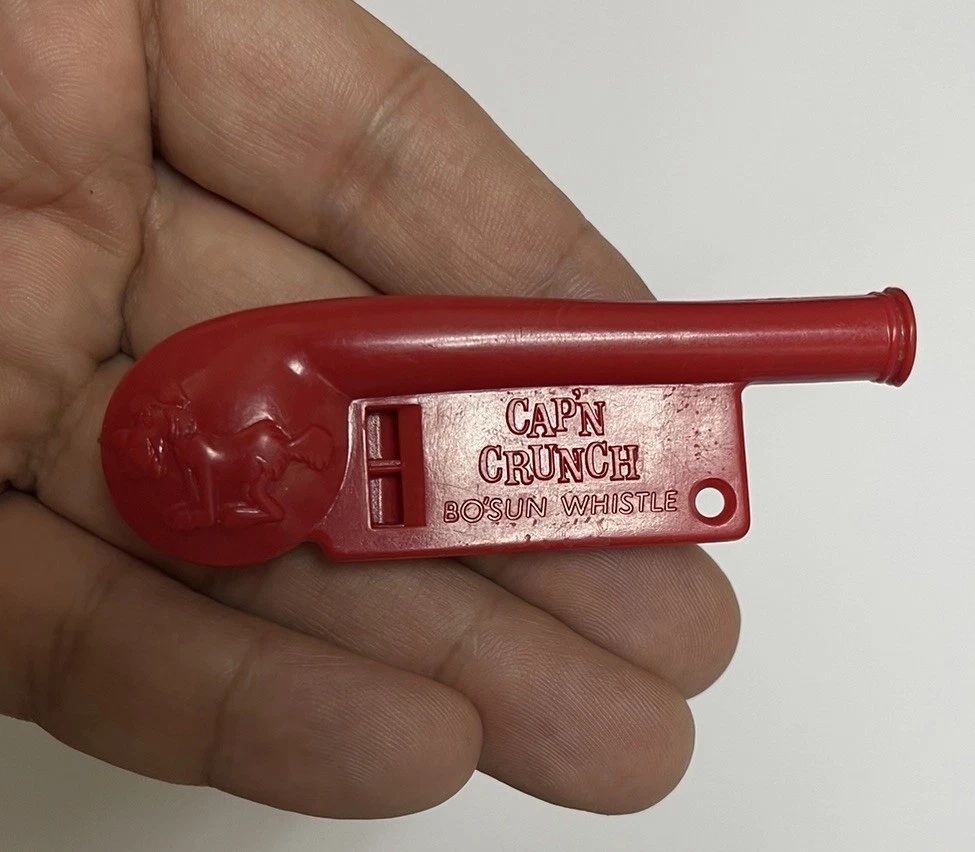
In the late 1960s, a peculiar treasure was tucked inside boxes of Cap’n Crunch cereal: a small, bright yellow plastic boatswain’s whistle. To most children, it was a simple toy. But for a specific community of electronics enthusiasts, that whistle was a skeleton key to the most complex machine on Earth: the AT&T long-distance network.
The American telephone system of the era relied on a vulnerability known as “In-Band Signaling.” This meant that the control signals (the instructions sent to the network’s computers) and the human voice traveled along the same path.
AT&T used a specific tone—2600 hertz—to manage its trunk lines. When a 2600Hz tone was detected, the system believed the caller had hung up and the line was now “idle” and ready for a new command. By emitting this tone while still on the line, a user could “seize” the trunk, effectively becoming the operator of their own call.
While the story is often centered on John Draper, the discovery actually began with a blind youth named Joe Engressia. Engressia possessed perfect pitch and discovered as a child that he could whistle 2600Hz directly into a phone receiver to disrupt the billing system.
It was John Draper, an Air Force veteran and electronics technician in his mid-20s, who realized the Cap’n Crunch toy whistle produced that exact frequency with one of its two holes taped over. Draper didn’t just stumble upon it; he refined the method. He realized that the whistle provided a consistent, mechanical way for anyone—even those without perfect pitch—to navigate the network’s hidden architecture.
The whistle was only the beginning. The phreaking community needed a special electronic box that would allow them to dial numbers in the same special way that telephone operators could. These became known as “Blue Boxes.” These devices could replicate all the multi-frequency (MF) tones used by operators to route calls.
This era famously captivated two young hobbyists in California: Steve Wozniak and Steve Jobs. Before they founded Apple, they were building and selling Blue Boxes to students at UC Berkeley. Jobs would later reflect that without the confidence they gained from “outsmarting” the billion-dollar AT&T network, Apple Computer might never have existed.
Draper, adopting the moniker “Captain Crunch,” became the catalyst for a burgeoning underground culture of similarly interested parties called “phone phreaks.” They spent their nights “phreaking”—generating call paths through tandem switches in distant cities, discovering secret internal numbers, and chatting in “loop-around” conference rooms.
For this community, the joy wasn’t in stealing long-distance service, but in the intellectual thrill of understanding a system so vast it seemed godlike. They shared knowledge through mimeographed newsletters and late-night calls, creating a proto-social network built on the bones of the telephone company.
“I don’t do it for the money. I don’t do it to rip off the phone company. I do it because I want to learn about the system.”
John Draper
AT&T eventually closed the loophole by moving to Common Channel Interoffice Signaling (CCIS), which separated the control signals from the voice path. By the mid-1980s, the 2600Hz whistle no longer held the power it once had. However, in-band signaling didn’t completely disappear until June 2006, when the final central office, located in Wawina, Minnesota (near Duluth), that had the vulnerable analog N2 carrier was replaced with a digital T1 line.
However, the legacy of the Cap’n Crunch whistle remains. It represents the birth of hacker culture—the idea that technology is not a “black box” to be blindly accepted, but a system to be questioned, explored, and understood.
If this grabbed your interest, for another terrific read, check out Ron Rosenbaum’s article called “Secrets of the Little Blue Box” that was published in the October 1971 edition of Esquire magazine. Here’s a link for you!